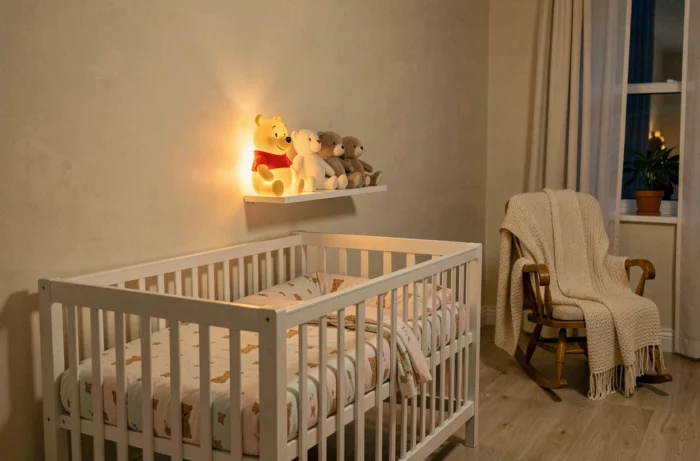
In the first few months, an infant does not distinguish between day and night. Their internal clock is still immature, and melatonin production only gradually sets in. In this context, choosing a Winnie nightlight is not just about a decorative object placed on the dresser. It is an element that directly influences the quality of the baby’s sleep, provided one understands how light affects their body.
Light Spectrum and Melatonin: How Color Choice Makes a Difference
You may have noticed that some nightlights offer multicolored modes, with blue, green, or purple cycling through? This type of light poses a concrete problem for an infant’s sleep.
Children, especially in preschool ages, are significantly more sensitive than adults to melatonin suppression by evening light. Even an intensity that seems low to an adult can hinder the production of this hormone in a baby. The recent consensus (2024-2026) is clear: only red or amber wavelengths preserve melatonin.
Specifically, if your Winnie nightlight offers multiple colors, prioritize the fixed amber or orange mode. Rainbow or bluish modes should be reserved for wakeful moments, never at bedtime or during the night. White light, even dimmed, contains blue wavelengths that disrupt falling asleep.
To prepare the baby’s sleep with a Winnie nightlight, you should check at the time of purchase that the model allows for selecting a fixed warm color, without flickering or automatic variation.

Winnie Nightlight Before Six Months: Placement and Intensity in the Room
Before six months, the infant’s room should remain as dark as possible during sleep phases. Recent recommendations suggest maintaining a very low light level, on the order of a few lux, and avoiding any white or blue diodes in the baby’s field of vision.
Why such a low threshold? Because the infant’s visual system is still developing. Their retina captures light with a sensitivity far greater than that of an adult. A Winnie nightlight placed on the changing table one meter from the face does not have the same effect as the same nightlight placed on the floor, directed towards the wall.
Where to Place the Nightlight Specifically
Direct the light towards the wall or floor, never towards the bed. The goal is to create a sufficient indirect halo so you can move around during nighttime feedings or changes, without the light source entering the baby’s field of vision.
- On the floor behind a piece of furniture, for low lighting that does not reach the crib.
- On a low shelf, facing the wall opposite the bed, so that the light bounces without dazzling.
- In timer mode if the model allows, so that the nightlight turns off after the nighttime feeding.
The Winnie nightlight serves parents during nighttime interventions. It should not remain on all night during the first months, unless the intensity is truly minimal and the color is amber.
Bedtime Routine with the Nightlight: Creating a Stable Signal
The baby’s sleep relies on regularity. An infant does not understand words, but they recognize sequences. Turning on the Winnie nightlight at the same time each evening (after the bath, after the last feeding) creates a sensory marker that the brain gradually associates with falling asleep.
The nightlight becomes a marker of transition between wakefulness and sleep. It is this repetition that gives it value, not the light itself. A three-month-old baby who sees the same amber glow appear each evening after the same actions begins to anticipate bedtime.
What Works Better Than a Musical Mode
Many Winnie nightlights incorporate melodies or white noise. White noise can help some infants fall asleep, but it creates a dependency if the sound stops in the middle of the night and the baby wakes up in silence.
Prefer a constant sound environment or complete silence. If you use the sound mode of the nightlight, set it to remain active for the entire duration of the sleep cycle, or do not use it at all. A sound that stops after twenty minutes becomes a factor for nighttime awakening.

Winnie Nightlight After Six Months: When Separation Anxiety Changes the Game
Around eight or nine months, most babies go through a phase of separation anxiety. Nighttime awakenings increase, and the child looks for visual markers by opening their eyes. It is at this stage that the nightlight takes on a different role.
A baby who wakes up in complete darkness and does not recognize their environment cries to call their parents. A constant amber glow allows them to locate their space without excessive stimulation. The Winnie nightlight, recognizable by its familiar shape, adds a stable visual marker.
- Keep the nightlight in fixed mode, without projection or light movement that could capture attention and delay falling back asleep.
- Maintain the amber or red color, even as the child grows. Sensitivity to blue light remains high well beyond the first year.
- Place the nightlight within the field of vision from the bed, but at a sufficient distance so that the perceived intensity remains very low.
The fear of the dark in the literal sense only appears around two and a half or three years, when imagination develops. Before this age, the nightlight meets a need for spatial reference, not a fear.
The choice of a Winnie nightlight for the first months relies on three technical criteria that matter more than design: amber or red color, adjustable intensity to a very low level, and the possibility of timer or continuous operation. The familiar character reassures both parents and the child, but it is the light spectrum that truly protects sleep quality.