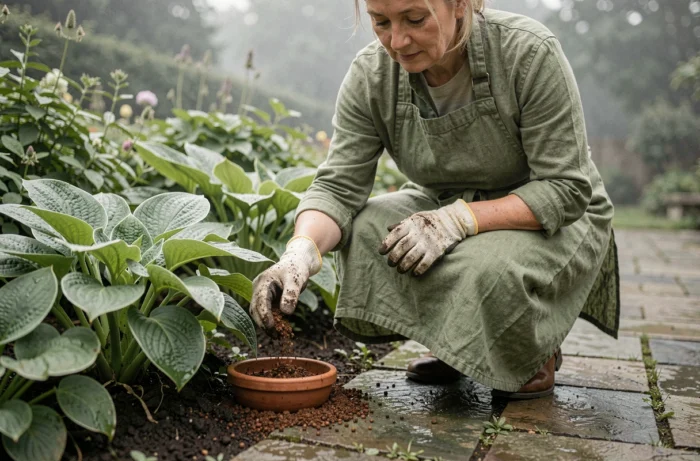
Woodlice are often found under pots, along wooden borders, or in overly damp mulch. Before trying to eliminate them, it’s important to clarify: coffee grounds are not an approved treatment against woodlice. Their role is limited to that of a temporary barrier and a moderate repellent, whose effectiveness strongly depends on ambient humidity and the frequency of renewal.
In other words, we’re talking about a complementary tool in a comprehensive garden management strategy, not a miracle solution. Understanding its limits allows for its wise use.
Dry coffee grounds against woodlice: why humidity changes everything
The first instinct when emptying a coffee filter is to place the grounds directly at the base of the plants. This is a common mistake that reduces the repellent effect to almost nothing. The grounds must be perfectly dry before any use in the garden. When wet, they ferment, develop mold, and attract precisely the type of environment that woodlice seek.
To dry them, spread them in a thin layer on a tray or plate, in the open air or in a ventilated area. In warm weather, a few hours are sufficient. In overcast weather, they can be placed in the oven for a few minutes at low temperature.
The topic of woodlice and coffee grounds in the garden often comes up in discussions among gardeners, and the consensus points in the same direction: wet grounds are counterproductive, while dry grounds form a granular barrier that these terrestrial crustaceans prefer to avoid.
After each rain or heavy watering, the barrier needs to be renewed. You don’t just apply the grounds once for the season. It’s a regular action to be integrated into the garden routine.
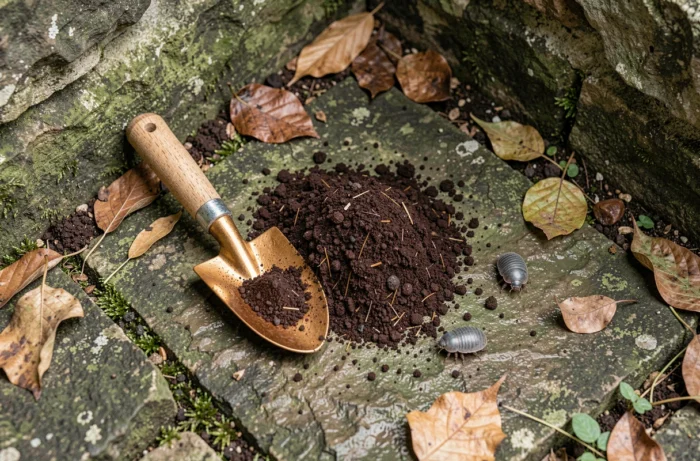
Spreading coffee grounds in the garden: the right thickness to repel woodlice
It is often said that you just need to sprinkle the grounds around the plants. In practice, the quantity and method of application are just as important as drying.
Avoiding the impermeable crust
A layer that is too thick of pure grounds forms a compact crust on the surface. This crust prevents rainwater and air from penetrating the soil, which suffocates the shallow roots and creates a stagnant wet area beneath it, exactly the type of micro-habitat favorable to woodlice.
Mixing the grounds with dry materials (shredded dead leaves, straw, wood chips) before spreading solves this problem. The goal is to achieve a mixture where the grounds make up only a fraction, not the entirety of the mulch.
Where to place the mixture
- Around the bases of sensitive plants, in a crown a few centimeters wide, without touching the stem or collar directly to avoid excess moisture at contact.
- Along wooden borders, low walls, or flat stones where woodlice shelter during the day: create a passage area that they prefer to avoid.
- Under overturned pots or elevated planters, renewing the layer with each cleaning of these spaces.
The ideal thickness of the mixture is around one centimeter. Beyond that, you fall back into the trap of the compact crust.
Are woodlice really a pest in the vegetable garden?
Before spreading coffee grounds everywhere, it’s beneficial to ask the right question. Woodlice are decomposers, not crop pests. They feed on dead organic matter: decaying leaves, damp wood, plant debris. Their presence in compost or mulch is even an indicator of good biological activity in the soil.
Feedback varies on this point, but the damage attributed to woodlice on living plants remains marginal and mainly concerns very tender young seedlings or fruits placed directly on damp soil (strawberries, for example). In most cases, if you observe woodlice on a damaged plant, they are consuming tissue already harmed by another factor.
The reasonable approach is therefore to protect vulnerable areas rather than treating the entire garden. Coffee grounds have their place around seedlings and fragile plants, not as a mass spread over all surfaces.

Coffee grounds and compost: attracting woodlice to the right place
A rarely discussed angle: coffee grounds in compost attract decomposers, including woodlice. A small amount added to an already warm pile accelerates biological activity. Earthworms, woodlice, and other microorganisms concentrate there, which indirectly keeps these populations away from cultivated areas.
We use the grounds as a tool for managing the garden ecosystem. Rather than repelling woodlice without offering them an alternative, we guide them towards the compost where their role as decomposers is beneficial.
For this strategy to work, the compost pile must remain sufficiently moist and contain a good balance between nitrogenous materials (peels, coffee grounds) and carbonaceous materials (cardboard, dry twigs). Coffee grounds provide nitrogen, potassium, and magnesium, nutrients that enrich the final compost and, by extension, the soil in the vegetable garden.
Complementing coffee grounds with other natural repellents
Grounds alone are not always enough, especially in a naturally humid or shaded garden. A few simple actions can enhance their effect without resorting to chemical products:
- Reduce moisture accumulation points: raise pots, space out waterings when possible, avoid overly thick mulches in shaded areas.
- Set up passive traps (halved citrus fruits turned upside down, boards laid on the ground) to concentrate woodlice and move them towards the compost.
- Combine the grounds with wood ash, which is also repellent to terrestrial crustaceans, in a thin layer around seedlings.
The combination of these actions yields better results than a single method applied in isolation. Coffee grounds act as a link in a chain of coherent practices.
Coffee grounds remain a supplementary repellent, effective when dry, regularly renewed, and associated with a reasoned management of soil moisture. Woodlice will not disappear from the garden, and that’s a good thing: their role in decomposing organic matter benefits soil fertility in the long term.