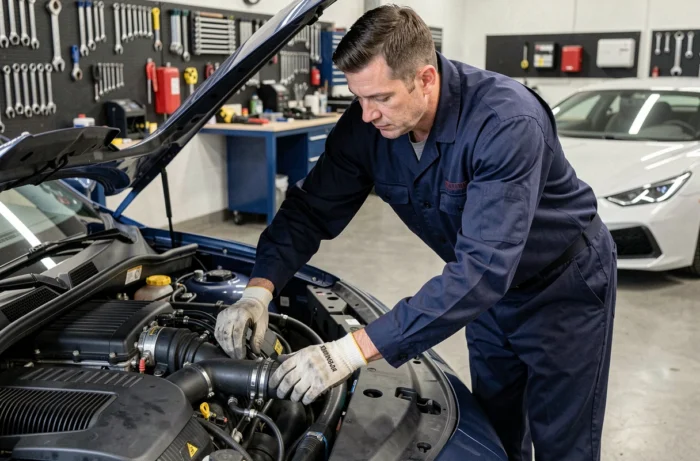
Automotive performance in 2024 is no longer just about a simple horsepower gain on the dynamometer. Regulatory constraints, the evolution of tires, and software updates are redefining what it truly means to optimize a vehicle, whether the engine is thermal or electric.
Engine remapping and individual vehicle approval: the legal framework that changes the game
Remapping remains the most direct lever to extract additional power from a thermal engine. However, we observe that most articles approach the topic from a purely technical angle, without addressing the legal reality in France.
Articles R321-16 and R322-8 of the Highway Code strictly regulate any significant modification of a vehicle’s technical characteristics. In practice, a gain exceeding approximately 30% of the original power requires an individual vehicle approval (RTI) from the DREAL. Without this process, the vehicle loses its compliance with the original homologation.
The direct consequence is insurance-related. A remapped vehicle outside the legal framework may have any claims denied by the insurer in the event of a serious accident. The actual performance of an engine preparation is therefore also measured by its ability to remain insurable and legally compliant after optimization.
Serious preparers now integrate the RTI procedure into their offerings, which extends timelines and increases overall costs but secures the investment. For owners looking to explore transformation possibilities for their vehicle, it is useful to learn more on mtm-france.com before embarking on a preparation project.

E85 conversion and combined remapping: economic performance under conditions
The E85 bioethanol attracts attention due to its significantly lower pump price compared to unleaded 95. Combining an E85 conversion with engine remapping allows for the exploitation of the higher octane rating of bioethanol to gain power while reducing fuel costs.
The legal trap is present. Two systems coexist in France, and we recommend not to confuse them:
- The approved box, regulated by a ministerial decree, which allows the use of E85 without modifying the vehicle’s homologation. The power gain remains marginal.
- The E85 mapping remapping, which directly modifies the engine control unit to take advantage of the higher octane. This approach offers significant gains but falls under the regime of modifying technical characteristics, with a potential obligation for RTI.
- The combination of both (box + remap) creates a regulatory gray area where neither system legally covers all modifications made.
A vehicle converted to E85 through remapping without homologation remains technically in violation. The savings at the pump do not compensate for a denial of compensation in the event of a claim.
Road-legal semi-slick tires: direct transfer from the track
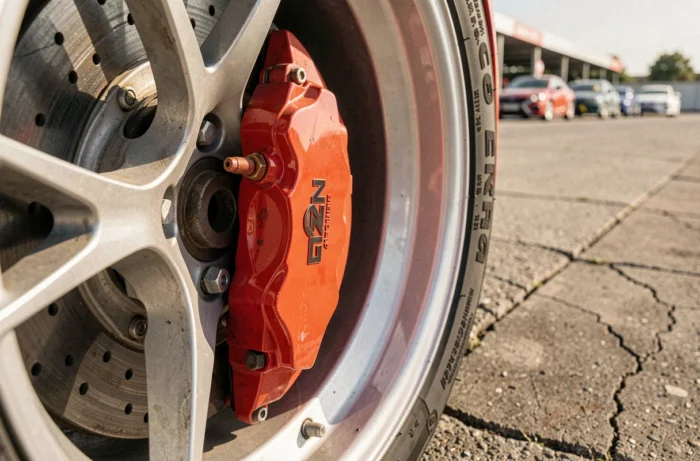
Manufacturers are accelerating the development of sport-oriented tires approved for road use. Bridgestone has developed the Potenza Race R specifically for the Lamborghini Revuelto SV, illustrating the trend of tires designed in partnership between manufacturers and tire companies for a specific model.
Pirelli follows the same logic with the P Zero R, tailored for Porsche and Audi. These tires are not just wider sport tires. They incorporate compounds derived directly from competition with minimal tread patterns, offering maximum contact surface on dry asphalt.
For less exclusive vehicles, the 245/40 R18 performance version offers accessible semi-slick tires. The challenge for the driver is to understand that these tires radically alter chassis behavior: mechanical grip increases, but the adhesion limit, once reached, drops more abruptly than with a standard touring tire.
OTA software updates: performance delivered without going to the workshop
Tesla has systematized over-the-air (OTA) updates in 2024 that modify vehicle performance parameters. Versions 2024.32, 2024.33, and 2024.44 have brought adjustments to power management, braking regeneration, and chassis behavior through stability control.
Software becomes the primary performance lever on an electric vehicle. Where a thermal vehicle owner must intervene mechanically, the driver of an electric vehicle receives measurable gains simply through a nighttime download.
This approach creates a new asymmetry in the automotive market. The value of a used electric vehicle now depends as much on its software version as on its mileage. An identical model can offer significantly different performance depending on whether it has received the latest updates.
Traditional manufacturers are beginning to adopt this model, with performance functions unlockable by subscription. The question of true ownership of the vehicle’s capabilities arises: does the customer purchase complete mechanical potential or modular software access?
Automotive performance in 2024 plays out on three simultaneous fronts: the regulatory compliance of engine preparations, the choice of competition-derived tires, and the exploitation of software updates. Neglecting any of these areas amounts to partially optimizing a system that functions as an integrated whole.