A pool turning green or cloudy in the middle of July is the scenario that all pool owners dread. The color of the water depends on a chemical and mechanical balance that deteriorates quickly due to heat, usage, and UV rays. Maintaining blue pool water all summer relies less on the quantity of products added and more on mastering a few specific parameters.
Accumulation of metals and residues in the pool: the invisible factor
Common advice focuses on chlorine, pH, and filtration. A more technical aspect remains underestimated: the gradual accumulation of metals and impurities in the water and equipment. Copper, iron, and manganese can come from the filling water, certain copper-based algaecides, or even from the corrosion of metal components in the hydraulic circuit.
These metals remain in solution as long as the pH and chemical balance are stable. As soon as a parameter drifts, they precipitate and color the water: a brownish tint with iron, greenish with copper. The problem is cumulative. Each addition of water adds a layer of residues that neither the filter nor the disinfectant can completely neutralize.
Salt electrolysis cells are particularly sensitive to this phenomenon. The accelerated scaling caused by metal deposits reduces their efficiency, which decreases chlorine production and promotes greening.
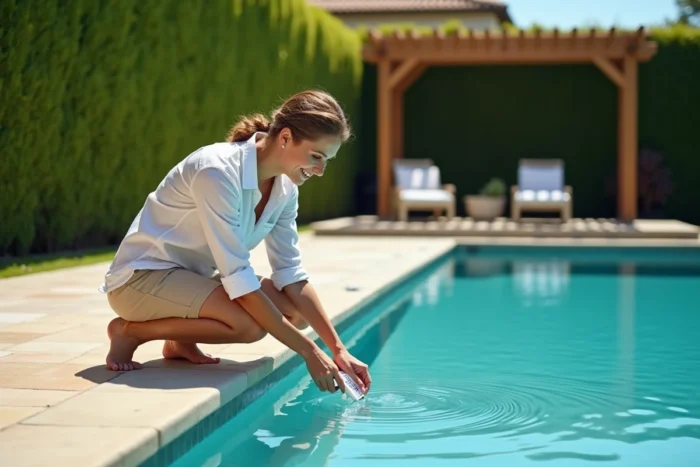
A detail to monitor through regular analyses with a kit capable of measuring metal levels, not just chlorine and pH. To delve deeper into methods that preserve blue pool water on Maisons Euro France, this chemical aspect deserves consideration even before discussing standard treatment.
Filtration in summer: adjust the duration to the thermometer, not to habit
Many owners schedule their filtration pump on a fixed time slot, often based on the manufacturer’s recommendations. In the height of summer, this approach becomes insufficient. The duration of filtration must increase proportionally to the water temperature, as heat accelerates the proliferation of microorganisms and degrades free chlorine more quickly.
The empirical rule is to divide the water temperature by two to obtain a minimum number of filtration hours. Beyond 28 or 30 degrees, some professionals recommend continuous filtration, including at night. Heatwave episodes are the times when pools most often turn, because filtration remains set to its spring setting.
When and how to filter during a heatwave
Filtering during the hottest hours (between 10 AM and 6 PM) is more effective than at night, as this is when temperature and sunlight most stress the water. If the pump cannot run continuously, prioritize this daytime slot.
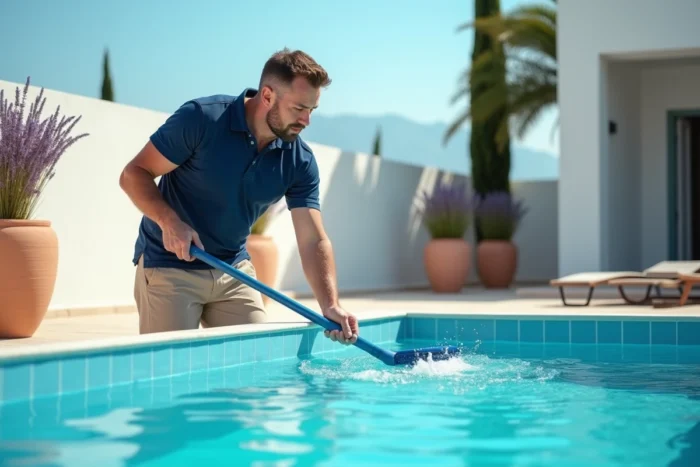
The filter itself deserves increased attention. A clogged sand filter loses a significant portion of its flow rate, which extends the time needed to circulate the entire volume of the pool. A weekly backwash becomes a minimum during peak season. For cartridge filters, rinsing every three to five days prevents saturation.
- Check the pressure on the filter gauge at least twice a week: an increase of 0.3 to 0.5 bar compared to the baseline value indicates clogging.
- Clean the skimmer and pump pre-filter baskets daily, as trapped organic debris consumes disinfectant and reduces flow rate.
- Consider a booster pump or an independent pool robot to supplement filtration in dead zones (bottom, corners) that the main circuit does not reach well.
Water analysis and chemical parameters: beyond pH and chlorine
The pH and chlorine level are the two values that every pool owner knows. Alkalinity (TAC) is the buffering parameter that stabilizes pH, and it is often the one that is forgotten to measure. Too low alkalinity makes pH unstable: it fluctuates after each swim, each rain, each product addition. As a result, chlorine loses effectiveness, and the water can become cloudy even with a correct disinfectant dosage.
The analysis should cover at least four parameters during the summer:
- The pH, which should be maintained within a narrow range (field returns vary slightly, but the target is around 7.2 to 7.4 for chlorine treatment).
- Free chlorine, which must remain at a sufficient level to disinfect without causing irritation. A discrepancy between free chlorine and total chlorine indicates an accumulation of chloramines, responsible for odor and irritation.
- Alkalinity (TAC), to be checked before adjusting pH, as correcting pH without stabilizing TAC is like emptying water from a leaky bucket.
- The stabilizer (cyanuric acid), which protects chlorine from UV rays but accumulates over the seasons. An excess of stabilizer blocks chlorine action, a phenomenon called over-stabilization that can only be corrected by partial draining.
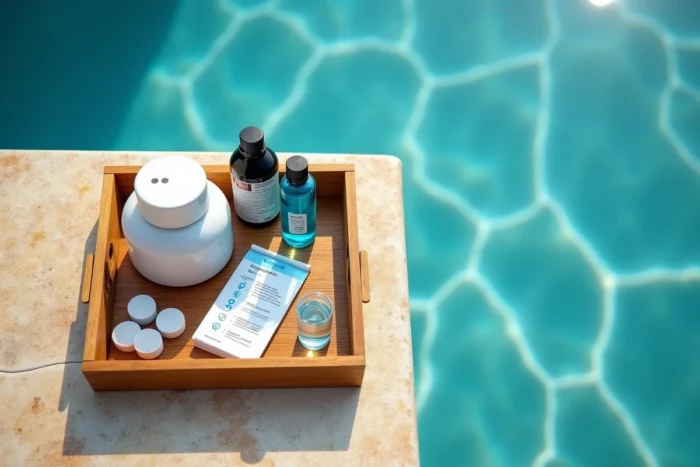
Treatment products: what the Certibiocide regulation changes
Pool treatment products are classified as biocides. Their marketing is regulated by the European regulation on biocidal products, and in France, Certibiocide certification is required for the distribution of these products. This regulatory framework has concrete consequences: some products sold online without this certification may have non-compliant dosages or incomplete compositions.
Prefer suppliers displaying the Certibiocide mention and complying with the REACH regulation to limit the risk of introducing substances that degrade equipment or distort the chemical balance into the pool. This is not an administrative detail; it is a guarantee of the quality of the product that ends up in the water where you swim.
Covering and protecting the pool from UV rays and debris
Ultraviolet rays degrade free chlorine at a high speed. An uncovered pool exposed to the sun consumes much more disinfectant than a covered pool during peak exposure hours. A cover or shutter also reduces evaporation and the introduction of organic debris, two factors that directly affect water clarity.
Outside of swimming hours, covering the pool slows the rise in water temperature, hinders algae growth, and decreases the workload on the filter. It is the simplest and least expensive measure to preserve blue color without multiplying chemical treatments.
Keeping blue water all summer depends more on consistency than on the quantity of products. A clean filter, filtration adjusted to the actual temperature, analyses that go beyond the simple pH-chlorine duo, and a cover placed right after swimming form a solid protocol.
The most common trap remains over-stabilization: when the stabilizer accumulates, even an overdose of chlorine is no longer sufficient. The only solution then is a partial renewal of the pool water.