
A freshly mowed lawn with irregular edges always gives an impression of unfinished work. The trimmer comes into play where the mower cannot reach: along walls, around trees, between patio slabs. Choosing the right model starts with understanding what distinguishes a tool suited to your terrain from a purchase that will end up at the back of the garage.
Battery compatibility: the criterion that selection guides underestimate
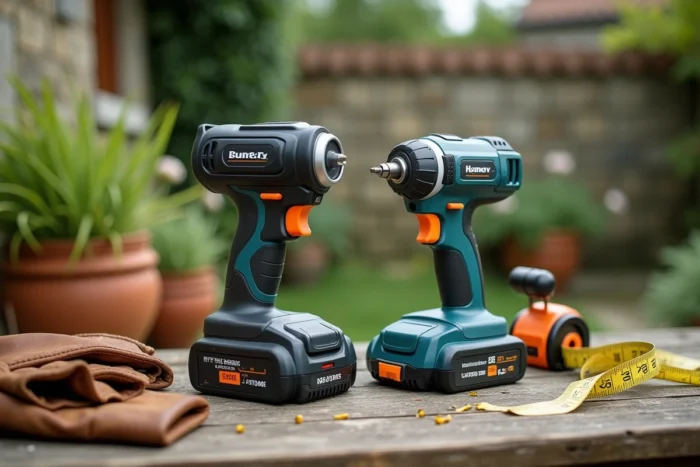
You may have noticed that major brands now offer complete ranges of tools that operate with the same battery? It’s no coincidence. The market for battery-powered outdoor maintenance equipment is the fastest-growing segment, driven by noise and emissions regulations.
Specifically, some manufacturers allow powering several dozen tools (trimmer, hedge cutter, pruning saw, mower) with a single battery platform of 18 to 40 V. If you already own a cordless tool from a particular brand, first check if a compatible trimmer exists in the same range. Buying an additional battery often costs as much as the tool itself.
This reasoning changes the purchasing logic. Instead of comparing trimmers one by one, compare the ecosystems. A well-stocked platform will save you from multiplying chargers and incompatible battery formats. The comparisons available on taille-bordure-warrior.com allow you to cross-reference models based on this compatibility criterion, among others.
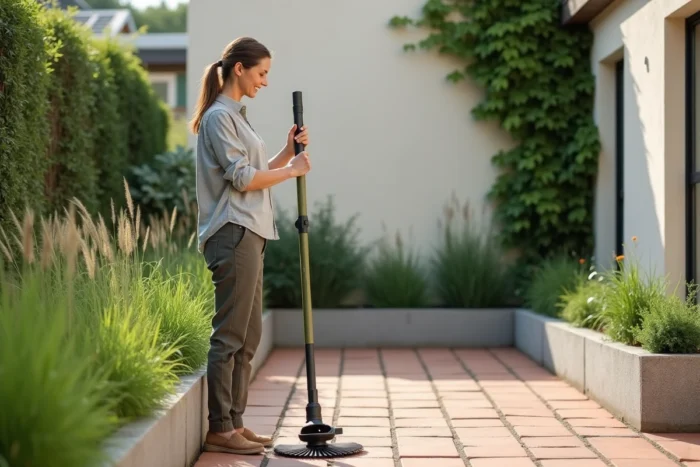
Line, blades, or knife: which cutting system for which use
The cutting system is the part that does the work. The choice here directly depends on what you will be cutting.
Nylon line, versatile but not universal
The majority of consumer trimmers use a nylon line that spins at high speed. It works well for soft grass and finishing along paths. There are two line feeding systems: the manual unwind spool (you pull the line yourself) and the automatic or semi-automatic feed system.
Round line cuts fine grass, while square or serrated line tackles tougher weeds. If your garden mainly consists of standard grass, a standard round line is sufficient. For dense grasses or tall weeds, a serrated profile will be significantly more effective.
Plastic blades or metal knife
Some models replace the line with rigid plastic blades or even a metal knife on more powerful devices. Plastic blades wear out faster but do not tangle. The metal knife is reserved for tasks close to brush cutting: brambles, woody vegetation, wasteland.
- Round nylon line: soft grass, edge finishing, common use around flower beds
- Serrated or square nylon line: tall weeds, dense grasses, overgrown fence edges
- Plastic blades: light use without risk of tangling, frequent replacement expected
- Metal knife: thick and woody vegetation, only on sufficiently powerful motors
Power and autonomy of the trimmer: adapting the motor to the terrain
Why does this point come after the cutting system? Because the power required directly stems from what you are cutting. A nylon line on short grass requires far fewer watts than a knife tackling brambles.
Wired electric: constant power, limited freedom
A wired electric trimmer never runs out of battery. It delivers stable power, making it suitable for small gardens near a socket. The obvious constraint is the cable. On a plot larger than a few hundred square meters, the extension cord becomes a real obstacle, especially around trees and flower beds.
Battery: the question of real autonomy
The autonomy claimed by the manufacturer rarely corresponds to intensive use. A manufacturer often measures autonomy in free cutting in fine grass. As soon as the vegetation resists, the motor consumes more and autonomy drops. For a medium-sized plot, plan for a battery of sufficient capacity, or a second battery charged in advance.
Battery models offer an often-overlooked advantage: a significantly lower noise level compared to gas models. In residential areas, this is a comfort argument for you and your neighbors.
Gas: raw power for large areas
The gas engine remains relevant for large surfaces or overgrown terrains. It delivers the highest power without autonomy constraints, as long as the tank is full. The downside: higher weight, engine maintenance (spark plug, filter, oil-gas mixture on two-stroke models), noise, and emissions.
Ergonomics and adjustments: what makes the difference in use
A trimmer can have the best engine on the market; if the handling is poor, every maintenance session becomes tedious. Two elements deserve your attention before purchasing.
The adjustable cutting head allows switching from horizontal cutting (classic edging) to vertical cutting (sculpting along a path) without straining the wrist. Not all models offer this function. Check that the tilt can be adjusted without tools, ideally with a simple button or dial.
The second point concerns the weight and balance of the device. A poorly balanced model tires the shoulder in just a few minutes. Some manufacturers include an auxiliary handle that can be adjusted in height and rotation. This detail radically changes comfort during sessions longer than a quarter of an hour.
- Ensure the main handle is non-slip and that the secondary one can be adjusted without tools
- Test the actual weight with the battery mounted, not the empty weight displayed on the product sheet
- Prefer a model with a shoulder strap or harness if your terrain exceeds a few hundred square meters
A good trimmer is one that matches your terrain, not the most powerful in the catalog. A small urban garden with grass borders does not need a gas engine. A large hilly terrain will not be well served by a wired model. Start from your actual use: type of vegetation, area to be treated, tools already in your possession. The rest will follow.