
Clay soil that sticks to boots in winter and cracks in summer, a hedge of thuja that drinks all the light, a poorly placed outdoor tap: most garden problems are resolved (or worsened) right from the planning phase. Before choosing plants or laying a terrace, it’s worth taking the time to observe what is actually happening on the ground for a few weeks, rain included.
Drainage and land slope: the often neglected starting point
People often start with plants or furniture. The instinct should be the opposite: check where water stagnates after a heavy downpour. A terrace without sufficient slope or a sunken bed is a breeding ground for mosquitoes and an asphyxiated soil in just a few seasons.
Recent recommendations for rainwater management emphasize a slope of about 2% for hard surfaces (terrace, pathways). Specifically, this represents two centimeters of elevation change per linear meter. Permeable pavers or porous slabs, with joints filled with filtering material, prevent water from flowing towards the house or forming persistent puddles.
If the land has a natural low area, it can be utilized with a rain garden (a slight depression planted with perennials tolerant of temporary moisture) rather than fighting against the topography. You can also find garden information on Brico Déco Jardin that details this type of approach to adapt landscaping to soil constraints.
Drought-resistant garden: plants that thrive without regular watering
For the past two years, nurseries have seen a growing demand for heat-resistant perennials. Rudbeckias, echinaceas, ornamental grasses, lavenders, shrub salvias: these plants are not just for the Mediterranean region. They adapt to most well-drained soils in France.
The common trap is wanting immediate results. Deep but infrequent watering in the first year forces roots to go deeper in search of moisture. Daily and superficial watering produces the opposite effect: a fragile root system that relies on the hose.
Mulching, a direct ally of soil and plants
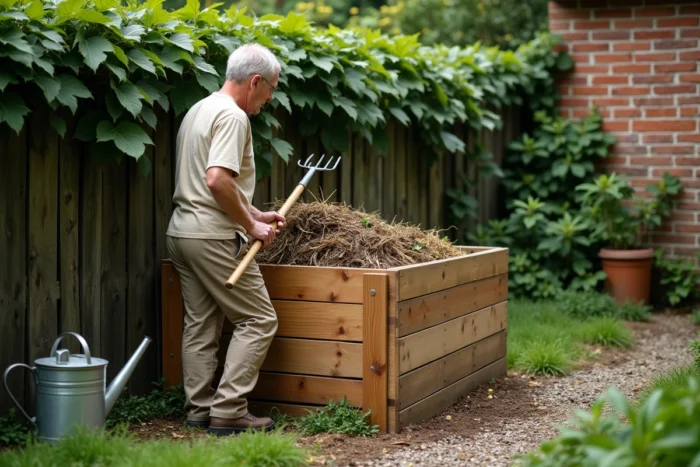
A thick mulch (wood chips, straw, dead leaves) laid down at least five to eight centimeters thick limits evaporation, nourishes soil life as it decomposes, and reduces the chore of weeding. On a well-mulched bed, maintenance time is significantly reduced from the second season onward.
Feedback varies on the type of mulch depending on the regions: conifer wood chips slightly acidify the soil, which is suitable for hydrangeas but less so for calcicole plants. Testing on a small area before generalizing remains the most reliable method.
Artificial intelligence tools applied to gardening
Applications that emerged in 2025-2026 allow users to photograph a patch of lawn or a flower bed to obtain a diagnosis: deficiency, fungal disease, weed identification. AI analyzes the image and suggests corrective actions tailored to the local weather.
There are also tools that cross-reference rainfall data, declared soil type, and planted species to calculate a personalized watering frequency. The gain is tangible on lawns: instead of watering out of habit, you water when the soil needs it, which reduces water consumption without sacrificing lawn quality.
These tools do not replace direct observation. A yellowing plant can suffer from both excess water and drought, and the algorithm does not always have access to the actual soil structure beneath the surface. They are used as decision aids, not as autopilot.
Seasonal garden maintenance: actions that truly change the outcome
Rather than an exhaustive month-by-month calendar, let’s focus on interventions whose impact is measurable over time.
- Reasoned pruning of shrubs: pruning at the right time (after flowering for spring-flowering shrubs, at the end of winter for others) avoids removing flower buds and limits plant stress.
- Soil aeration at the base of trees and in compacted beds, once a year in spring, with a simple garden fork. An aerated soil absorbs water better and promotes biological activity.
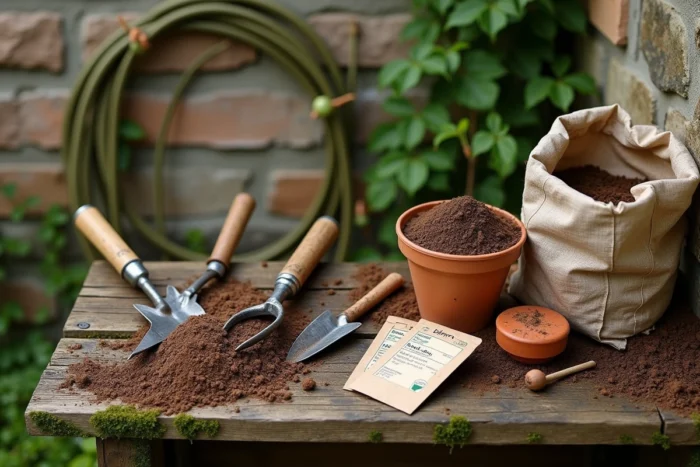
- Cleaning gardening tools after each heavy use (pruning, working with wet soil). A clean and sharp pruner makes clean cuts that heal quickly, whereas a dirty or crushed blade opens the door to diseases.
- Regular monitoring of water stagnation points: saucers under pots, hollows in the mulch tarp, poorly oriented gutters. Removing these micro-reservoirs reduces mosquito proliferation much more effectively than chemical treatments.
Adapting the maintenance plan to the actual size of the garden
A garden of less than one hundred square meters does not need a robotic lawn mower or an underground irrigation system. A manual reel mower and a watering can are sufficient, and the weekly maintenance time remains under one hour.
For larger areas, the choice between a robotic mower and a gas mower mainly depends on the configuration: slope, obstacles, shape of the land. A steep or very fragmented terrain complicates the use of a robot and may require additional adjustments (peripheral cables, exclusion zones).
The best indicator of the success of a garden layout is not the photo from the first summer. It is the state of the land three years later, when the plants have settled in, the soil has stabilized, and the maintenance time corresponds to what one is willing to dedicate each week.