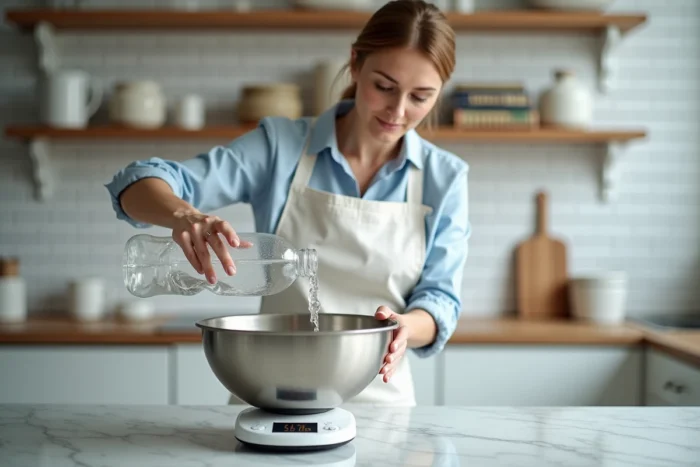
Converting 1.5 liters to kilograms seems simple, until the liquid in your container is no longer water. The quick answer (1.5 kg) only works in a specific case, and most online conversion tables overlook this detail. It all hinges on a variable that automatic converters often treat as a constant: density.
Why density changes the result of a liter to kg conversion
The basic formula is straightforward: mass (kg) = volume (liters) x density (kg/L). For pure water, the density is close to 1 kg/L, which gives 1.5 liters = 1.5 kg. This equivalence is etched in school memories.
The problem is that this equality is only strictly true around 4 °C, when the density of water reaches its maximum, close to 1,000 kg/m³. Beyond that, density decreases with temperature. At 25 °C, the difference remains small for household use, but it becomes significant in laboratory or industrial production.
As soon as we move away from water, the numbers change much more. Olive oil has a density of about 0.92 kg/L: 1.5 liters then weighs around 1.38 kg. Whole milk hovers around 1.03 kg/L, which is about 1.545 kg for the same volume. For those looking to convert 1.5 liters to kg accurately, identifying the density of the liquid in question is the only step that matters.

Conversion of 1.5 liters to kg for cooking ingredients
In cooking, the conversion from liters to kilograms is a recurring headache because recipes merrily mix volumes (centiliters, spoons, glasses) and masses (grams, kilograms). A measuring cup graduated in milliliters does not provide the weight of the flour it contains.
Common liquids in cooking
Water, vinegar, and broth have densities very close to 1 kg/L. For these liquids, 1.5 liters corresponds to about 1.5 kg without any notable adjustment.
Milk is slightly above 1 kg/L due to the suspended fats and proteins. Thick cream, being denser, also exceeds this threshold. In contrast, vegetable oils (sunflower, olive, rapeseed) are consistently lighter than water.
Dry ingredients measured by volume
Some Anglo-Saxon recipes use the cup as a volume unit for dry ingredients. Converting a volume of flour to grams requires knowing its bulk density, which depends on how packed it is.
- Packed wheat flour in a container does not have the same density as flour simply poured: the difference can reach several tens of grams per liter.
- Granulated sugar is significantly denser than flour: 1.5 liters of sugar weighs much more than 1.5 liters of flour.
- Flakes (oats, cereals) are very low in density, and 1.5 liters of flakes often weighs less than one kilogram.
Weighing the ingredient directly with a kitchen scale remains the most reliable method. The conversion table displayed on a package of flour or sugar provides a useful approximation, but each brand may vary slightly.
Limitations of online converters for non-liquid materials
Automatic conversion tools typically offer a dropdown list of liquids with a fixed pre-recorded density. This approach works correctly for water, milk, or oil. It becomes misleading for granular materials like sand, concrete, or aggregates.
The bulk density of sand typically varies between 1,400 and 1,800 kg/m³ depending on the type (fine sand, river sand, crushed sand) and its moisture content. The same volume of 1.5 liters can therefore weigh between 2.1 and 2.7 kg depending on the sand used. Applying a single density leads to concrete dosage errors, especially for mortar or concrete mixes on a construction site.
The available data does not allow for a universal density to be set for these materials. Their particle size, water content, and degree of compaction change the result. A serious sand quantity calculator requires specifying the exact type of material, whereas a simple liter-to-kg converter displays a single figure.

Practical method for successful volume-mass conversion
Rather than an exhaustive table, here are the concrete steps to convert any volume to mass without error.
- Identify the liquid or ingredient. The density of water, milk, oil, or flour has nothing in common.
- Find the density. The product label, a technical sheet, or an online reference table will suffice. Check the unit: kg/L or g/mL (both are numerically identical).
- Apply the formula: mass = volume x density. For 1.5 liters of a liquid at 0.92 kg/L, the calculation gives 1.5 x 0.92 = 1.38 kg.
- Adjust if temperature matters. For household use, the difference is negligible. For industrial or laboratory dosing, specifying the temperature of the liquid changes the density value and thus the final result.
This method applies to both centiliters (divide by 100 to get liters) and milliliters (divide by 1,000). The principle remains the same regardless of the starting volume unit.
Remember that 1.5 liters of water weighs 1.5 kg is a useful benchmark in daily life. For any other liquid or material, density is the only parameter to check. Without this data, no converter, no matter how sophisticated, can guarantee a reliable result.