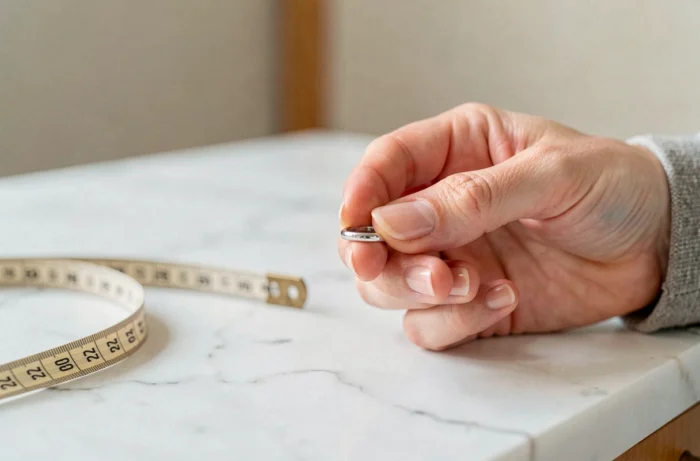
When ordering a ring online, you spot the mention “size 9” on an American site, and you find yourself unsure if it will fit your finger. Size 9 in the US system corresponds to a inner circumference of about 59.5 to 60 mm and an inner diameter close to 19 mm. In French sizing, this translates to a 59 or a 60 depending on the manufacturer’s rounding.
The difficulty lies in these roundings, which vary from one chart to another.
Why ring size 9 conversion charts are not always accurate
The American system numbers sizes in increments (5, 6, 7, 8, 9, etc.), while the French and European systems are based directly on the inner circumference in millimeters. A French size 54 means 54 mm of inner circumference. This logic stems from the ISO 8653 standard, widely adopted by French and European jewelers.
The problem arises when converting from one system to another. A US size 9 fluctuates between 59.5 and 60 mm in circumference according to different sources. Some sites round down to 59 mm, others round up to 60 mm. A millimeter difference may seem trivial, but on a thin ring, it changes the feel when worn. If you search for what ring size in mm corresponds to size 9, you’ll find values that differ slightly from one chart to another for this reason.
Keep a reliable reference in mind: US size 9 equals an inner diameter of about 19 mm. This diameter is the easiest measurement to check at home, without a professional ring sizer.
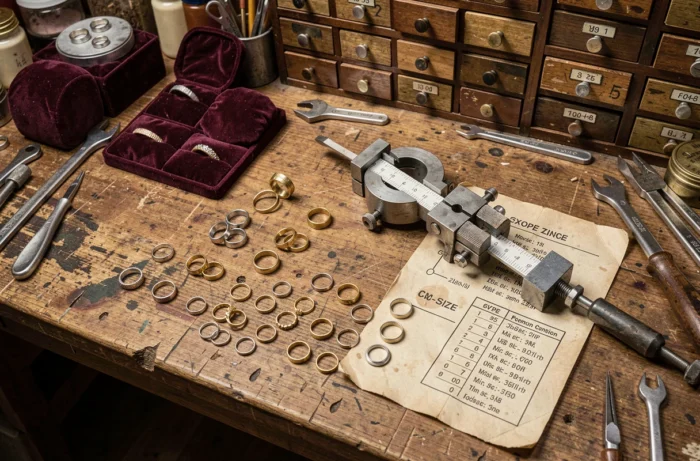
Measuring your finger circumference in mm without a professional ring sizer
Before relying on a chart, you need a reliable measurement of your own finger. Three methods work at home, provided you follow a few precautions.
The paper strip or string method
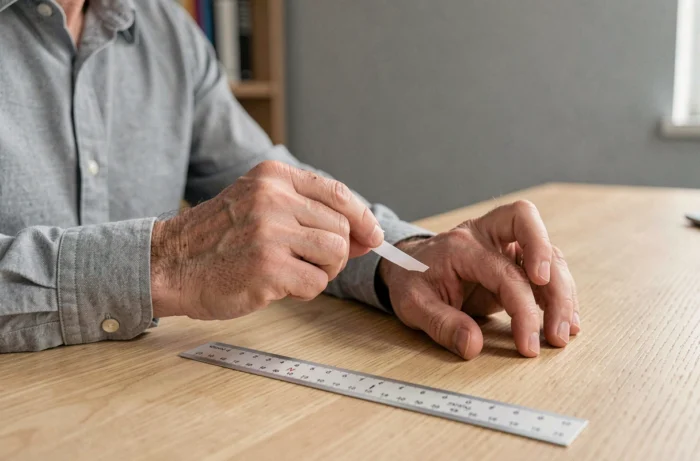
Cut a strip of paper about 10 cm long and 5 mm wide. Wrap it around the base of the finger in question, not tight enough to compress the skin, but snug enough that it doesn’t slip. Mark the overlapping point with a pen, then measure the length obtained with a ruler graduated in millimeters.
This length directly gives the circumference of the finger in mm, thus the French size. If you get 59 mm, you wear a 59, which is equivalent to a US size 9.
The diameter method with an existing ring
Place a ring that fits well on a white sheet of paper. Draw a line with a pencil inside the circle, from one edge to the other through the center. Measure this line: it’s the inner diameter. To convert to circumference, multiply by 3.14.
A diameter of 19 mm gives about 59.7 mm of circumference, thus a French size 60 (rounded up). Returns vary on this point according to brands: some fit slightly tighter, others looser.
Precautions that affect the result
- Measure at the end of the day, when fingers are slightly swollen from activity and heat. In the morning, the finger circumference can be smaller by half a millimeter to a millimeter.
- Avoid measuring after a hot shower or intense physical exertion: temporary swelling skews the measurement upward.
- Repeat the measurement three times over two different days and keep the median value, not the smallest or largest.
These precautions may seem excessive, but an error of just one millimeter in circumference can shift you from one size to another.
Ring size conversion chart: US size, diameter, and finger circumference
Instead of navigating through several contradictory sources, here are the reference values for size 9 and its immediate neighbors:
| US Size | Inner Diameter (mm) | Circumference (mm) | FR/EU Size |
|---|---|---|---|
| 8 | 18.1 | 57 | 57 |
| 8 1/3 | 18.5 | 58 | 58 |
| 8 2/3 | 18.8 | 59 | 59 |
| 9 | 19.1 | 60 | 60 |
| 9 3/4 | 19.4 | 61 | 61 |
The FR/EU size directly corresponds to the circumference in millimeters. No additional calculation needed when using the European system: the size number is the measurement.
Ring size 9 too big or too small: how to decide
You measured 59 mm of finger circumference. US size 9 corresponds to 60 mm. Should you choose a 59 or a 60? The answer depends on the type of ring.
A thin band (less than 3 mm wide) can be worn comfortably even if slightly adjusted. You can choose the 59. A wide ring (6 mm and more) tends to fit tighter because it covers more skin surface. For a wide ring, go up half a size, which would be the 60 in this example.
The metal also plays a role. Gold and platinum maintain their shape over time. Silver, being softer, can slightly ovalize with daily wear, which gives a looser feel after a few months.
- Thin band on a finger measured between two sizes: take the smaller size.
- Wide ring or ring with stones set on top: take the larger size.
- Ring intended for the left ring finger (wedding band): measure this finger specifically, not the other hand. The difference between the right and left hand can sometimes reach half a size.
Most online jewelers offer free size exchanges on standard models. Checking this option before ordering remains the simplest safety net when you’re unsure between two neighboring sizes.
The mm conversion for a size 9 ring boils down to two numbers: 19 mm in diameter, 60 mm in circumference. With a measurement taken under good conditions and the right choice between high size and low size depending on the width of the band, the risk of error becomes very low.