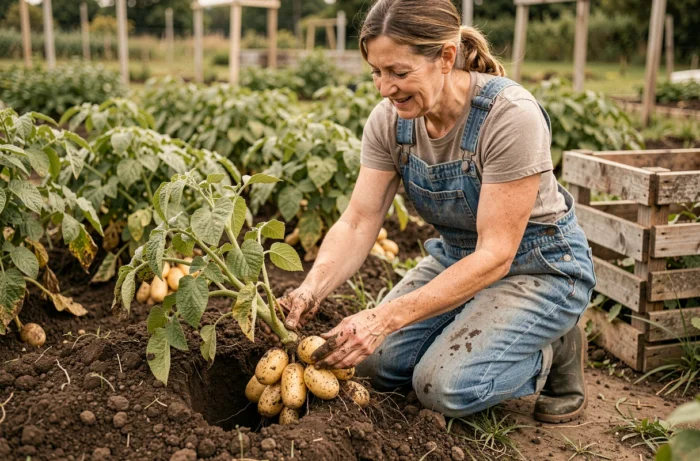
The maturity of a potato is not only determined by the foliage. The dried stems remain a useful indicator, but in 2026, repeated droughts and smaller sizes require cross-referencing multiple indicators before grabbing the fork and spade. Harvesting at the right stage protects the quality of the tuber as much as the yield.
Tuber sizes in 2026: why foliage is no longer enough
Gardening guides repeat that you should wait for the foliage to yellow and lie flat on the ground before harvesting. This rule holds true in a normal season, but 2026 is not one of those.
The potato interprofessional organization reports significantly reduced yields and smaller sizes due to lack of rain. The tubers also suffer from physiological disorders that affect their storage quality.
The concrete trap: the foliage can remain green while the swelling is already severely impacted. Waiting for complete drying does not yield additional size and increases the risk of rot in dry, crusty soil. By following the advice from Les Jardins de Camille, it becomes clear that a slightly early harvest better protects the tubers than prolonged waiting out of habit.
The technical recommendation for this season: dig up a few test plants during the growing season to directly observe the size and condition of the tubers, rather than relying on a theoretical date or just the aerial appearance of the plant.
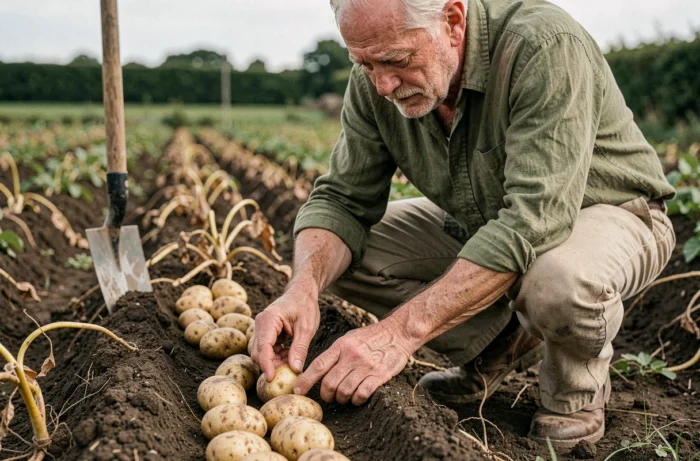
Skin maturity test: the reliable method before harvest
The peeling test is the most reliable gesture to check if a tuber is ready. It involves rubbing the skin of the potato with your thumb. If the skin comes off easily, the tuber has not finished maturing: its skin is not yet suberized, and it will not store well.
When the skin resists rubbing and remains firmly attached to the flesh, the potato has reached its physiological maturity. This test is performed directly in the vegetable garden, on two or three tubers dug up from different spots in the plot.
Why this test matters more than counting days
Varietal sheets indicate indicative growing durations. Early varieties are generally harvested between 70 and 90 days after planting, while storage varieties are harvested between 120 and 150 days.
These ranges assume a regular climatic season. In 2026, episodes of drought and thermal shocks shift maturation unpredictably. The skin test remains the only indicator that reflects the actual state of the tuber, regardless of the calendar.
Harvesting potatoes according to variety category
The harvest date primarily depends on the type of variety grown. Three main categories structure the calendar in the vegetable garden:
- The early varieties (Amandine, Belle de Fontenay, Sirtema) reach maturity first, often by the end of spring. Their foliage yellows quickly, and the tubers are consumed fresh, without long storage.
- The semi-early to semi-late varieties (Charlotte, Monalisa) mature in mid-summer. They offer a good compromise between size and storage ability.
- The late varieties (Vitelotte, Désirée) are harvested in late summer, sometimes early autumn. These are the ones that store best in a cellar, provided the skin is well-formed at the time of harvesting.
Regardless of the category, dried foliage and the skin test remain the two validation criteria before harvesting.
Soil and weather conditions at the time of potato harvest
Even when the tubers are ready, the timing of harvesting also depends on the state of the soil. Harvesting at the wrong time damages the potatoes and compromises their storage.
- Choose a day without rain for at least 48 hours. Wet soil sticks to the skin, promotes injuries, and accelerates the development of fungal diseases during storage.
- Avoid days of intense heat. A tuber exposed to direct sunlight can turn green within hours due to solanine. Harvesting early in the morning or late in the day minimizes this risk.
- In 2026, dry and crusty soils complicate harvesting with a fork and spade. A light watering the day before (without soaking) facilitates tool penetration and reduces mechanical shocks to the tubers.
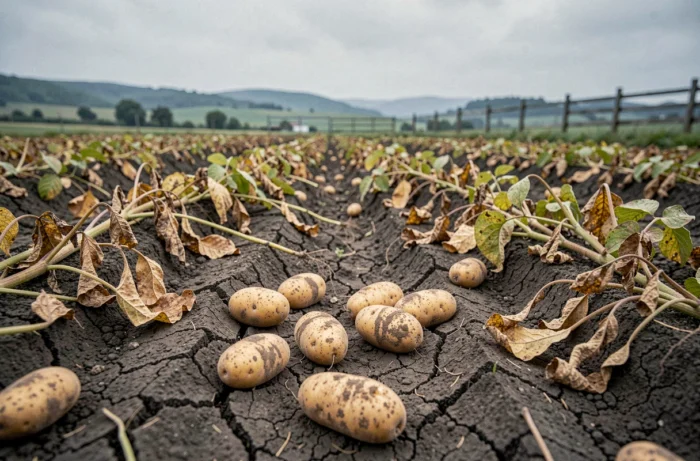
Physiological defects to watch out for in 2026
Water fluctuations during the season promote defects such as hollow heart or growth cracks. These anomalies are not visible from the outside: only cutting a test tuber allows them to be detected.
If several potatoes show these defects, it is better to quickly harvest the rest of the plot rather than wait for additional swelling that will not improve quality.
Storage after harvest: actions that extend storage duration
A well-timed harvest is useless if storage is neglected. After harvesting, allow the tubers to dry for a few hours in the open air, in the shade, so that the skin hardens. This curing phase reduces the surface moisture content and slows down rot.
Then store in a dark, ventilated space with a stable temperature around 6 to 8 °C. Light causes greening, and a temperature that is too high restarts germination within weeks.
Systematically sort: any tuber that is injured, cracked, or has a suspicious spot should be consumed first and separated from the storage batch. A single diseased tuber can contaminate an entire crate in the cellar.
Harvesting potatoes in 2026 is managed tuber by tuber, not on a fixed calendar. Digging up a few test plants, rubbing the skin, observing actual sizes: these three simple actions replace any general rule in a season where the climate disrupts the usual markers of the vegetable garden.