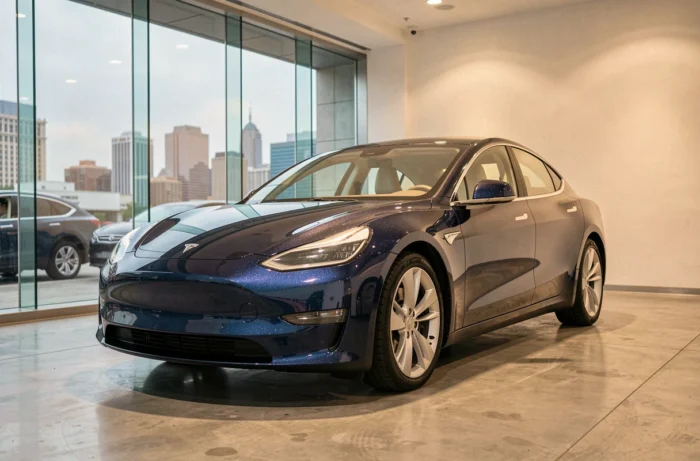
The automotive sector is undergoing an unprecedented regulatory and technological shift in 2026. With the implementation of the Euro 7 standard, the tightening of the ecological penalty in France, and the market share of electric vehicles reaching new heights in Europe, the usual benchmarks for buyers and manufacturers are changing rapidly.
Euro 7 Environmental Passport: What the Standard Requires for New Vehicles Starting November 2026
Competitors are widely covering model launches and sales rankings. However, a less publicized aspect deserves special attention: the regulatory framework that redefines what a manufacturer is allowed to sell.
Starting from November 29, 2026, every new type of passenger car or light commercial vehicle approved in the European Union must include an environmental passport for the vehicle. Specifically, a QR code accessible within the cabin will allow users to consult data on actual emissions and, for electric models, the health status of the traction battery.
The durability thresholds imposed by Regulation (EU) 2024/1257 set a minimum of 80% battery capacity after 5 years or 100,000 km, and then 72% after 8 years or 160,000 km. These figures are not indicative; they condition the approval process. A manufacturer whose batteries do not meet these thresholds simply could not market the affected vehicle.
For the used car market, the implications are direct. The environmental passport creates a traceability that did not exist before, which could change the perception of the residual value of electric vehicles. The available data does not yet allow for measuring the impact on resale prices, but the transparency imposed by this system redistributes the cards between virtuous manufacturers and low-cost assemblers.
To keep track of these developments over the months, City Automobiles news regularly covers the concrete implications of these regulatory changes for motorists.
CO2 Penalty and Weight Penalty in France: The Double Filter of 2026
Since January 1, 2026, the French definition of a “clean vehicle” has shifted towards zero emissions. This change in terminology is not cosmetic: it is accompanied by a simultaneous tightening of the CO2 penalty and the weight penalty.
The threshold for triggering the CO2 penalty has been lowered to 108 g of CO2 per kilometer. On the weight side, the threshold is set at 1,500 kg. A thermal segment C SUV, which often weighed just below the old threshold, now falls into the taxed zone. The combination of the two penalties can represent a significant additional cost at purchase, which mechanically directs demand towards hybrid or electric powertrains.
European manufacturers are adapting their ranges accordingly. Renault, for example, has announced 19 new models planned by 2029, with an increasing share of electrified models. The trend also affects premium brands: reducing a vehicle’s weight by a few dozen kilograms can shift its penalty from one bracket to another, prompting engineering departments to rethink material and equipment choices.
Electric Vehicles in Europe: The Milestone of One in Four Registrations Surpassed
In July 2026, the market share of new electric cars exceeded 25% of registrations in Europe, particularly driven by France and Germany. This symbolic threshold masks contrasting realities depending on the countries and segments.
Several factors explain this progression:
- The CAFE (Corporate Average Fuel Economy) targets impose increasingly lower fleet emission averages on manufacturers, encouraging them to boost sales of zero-emission models through discounts or attractive financing offers.
- The network of charging stations continues to densify, although field reports vary on the reliability and actual availability of fast charging points on highways.
- The arrival of more affordable electric models, such as the new Dacia Spring or Chinese B-SUVs (like the Leapmotor B03X), broadens the base of potential buyers.
However, the used electric market is aging faster than expected. The first generations of electric vehicles, whose real range has decreased over the years, are appearing on the secondary market with significant depreciation. The Euro 7 environmental passport could, in the long run, clarify this situation by providing used car buyers with a reliable diagnosis of the battery’s condition.
Chinese Manufacturers in the European Market: Offensive at the 2026 Paris Motor Show
The Paris Motor Show, scheduled for October 12-18, 2026, illustrates a geographical shift in the automotive industry. According to the organizers, 20 Chinese brands will be present alongside 24 international manufacturers. This near parity would have seemed unthinkable at the 2022 edition.
MG, BYD, Xpeng, Jaecoo, and soon Geely are now regularly appearing in the monthly registration rankings in France, alongside historic brands like Citroën and Hyundai. Leapmotor, through its partnership with Stellantis, is even preparing to produce models on European soil.
The question of trust remains open. The warranties offered by these manufacturers often reach five years or more, but their distribution and after-sales networks are still less established than those of European brands. The real test will come with the first large-scale feedback on medium-term reliability and the availability of spare parts.
Plug-in Hybrid or Non-Plug-in: A Motorization Choice That Is Becoming More Complex
Faced with the tightening of penalties and the rise of electric vehicles, hybrid powertrains play a transitional role. The market offers three main technologies: micro-hybrid (MHEV), conventional hybrid (HEV), and plug-in hybrid (PHEV). Each responds to a different usage profile, between short urban trips and long highway journeys.
The PHEV remains the most versatile on paper, but its fiscal advantage has diminished with the redefinition of clean vehicles. Only zero-emission vehicles now benefit from the ecological bonus, which repositions the PHEV as a technical compromise rather than a fiscally optimized choice.
The year 2026 marks a turning point where automotive purchasing decisions are no longer made solely based on design or list price. The regulatory framework, the transparency imposed by Euro 7, and the reshaping of the competitive landscape with the massive arrival of Chinese manufacturers weigh as heavily as the technical characteristics of a model. The coming months, with the Paris Motor Show and the effective implementation of the environmental passport, will provide concrete answers regarding the direction the market is taking.