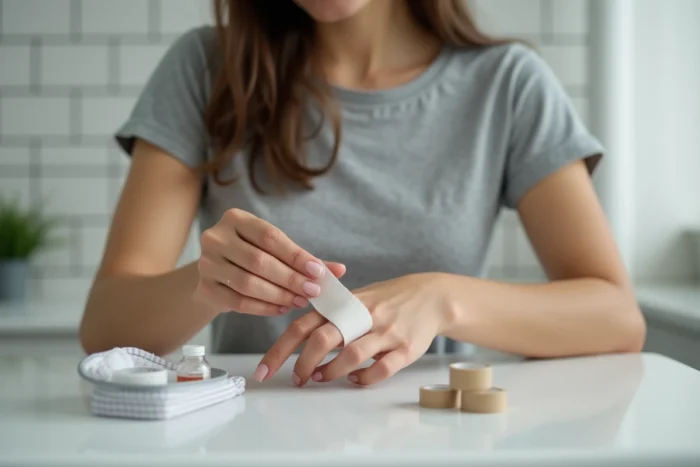
The healing of a torn nail depends on several factors that classic guides rarely address together: the condition of the matrix, the type of dressing used, and underlying nutritional deficiencies. Comparing these variables helps to understand why some regrowths take twice as long as others, and why the same trauma produces very different results depending on the care applied.
Healing in a moist environment or in open air: compared data
The choice of dressing after a torn nail conditions the healing speed of the exposed nail bed. Modern healing guides show that a warm and slightly moist environment under the dressing promotes faster healing and reduces the risk of hypertrophic scarring, compared to a wound left consistently exposed to the air.
| Criteria | Moist occlusive dressing | Dry compress / open air |
|---|---|---|
| Healing speed | Faster (environment favorable to cell migration) | Slower (dry crust hindering regeneration) |
| Risk of hypertrophic scarring | Reduced | Higher |
| Risk of infection | Low if regularly changed | Variable (exposure to ambient bacteria) |
| Daily comfort | Better (protection against friction) | Increased pain on contact |
This approach of moist healing is now applied to the exposed nail bed: non-compressive occlusive dressing, regularly changed, rather than a simple dry compress over the long term. Most competing articles mention the dressing without specifying this evolution in practice.
To delve into the disinfection and bathing protocols suitable for healing a torn nail, the choice between aqueous antiseptic and saline solution deserves particular attention depending on the degree of trauma.

Nail matrix and regrowth: when trauma changes everything
The nail matrix, located under the base of the nail, produces the keratin that forms the plate. When a shock or tear affects this area, the regrowth can be permanently altered: ridged, deformed nails, or nails that only partially regrow.
Partial or total tear: two distinct scenarios
A partially torn nail often retains a portion of functional matrix. Regrowth remains possible, even if it takes several months for a finger and significantly longer for a toe. A total tear affecting the matrix requires a quick consultation to assess whether surgical repair is feasible.
Signs of an affected matrix include heavy bleeding at the base of the nail, persistent localized pain under the cuticle, and visible deformation of the nail bed in the following weeks. If the matrix is intact, regrowth follows a regular, albeit slow, pace.
Monitoring in the first weeks
The trauma area remains vulnerable throughout the regeneration phase. A nail that regrows irregularly, with marked ridges or abnormal thickening, may signal partial matrix damage. In this case, a dermatologist or podiatrist can guide towards appropriate treatment.
Risk of infection and onychomycosis after a torn nail
An exposed nail bed constitutes an entry point for bacteria and fungi. This risk is often underestimated in the first weeks, while it is precisely the most critical period.
- Bacterial infection: redness, swelling, increasing pain, and possibly purulent discharge. It occurs mainly in cases of insufficient disinfection or poorly changed dressings.
- Secondary onychomycosis: the combination of a traumatized nail bed, closed shoes, and humidity increases the risk of developing a fungal infection on the regrowing nail. Prolonged monitoring over several months is recommended.
- Warning signs justifying a consultation: local fever, red streaks extending from the area, pain that intensifies instead of decreasing after the first few days, or unusual odor.
Disinfection with an aqueous antiseptic (such as chlorhexidine) remains the first step. Alcohol-based solutions should be avoided on an exposed nail bed as they cause sharp pain and may delay the healing of fragile tissues.
Nutritional deficiencies and slow nail regrowth
When regrowth seems abnormally slow or the new nail appears brittle and ridged, the nutritional aspect deserves exploration. Teams now recommend, in cases of nail trauma with slow regrowth, to look for possible iron or vitamin D deficiency.
These deficiencies are associated with keratinization disorders and longer healing times for tissues, including at the level of the nail matrix. A simple blood test can identify them.
Nutrition and keratin: the concrete link
Iron is involved in transporting oxygen to the matrix cells. Vitamin D influences the differentiation of keratinocytes. A deficiency in either slows down keratin production, resulting in a nail that grows more slowly and remains fragile for months.
This aspect is rarely mentioned in popular articles about torn nails, even though it concerns a significant portion of the population, particularly women of childbearing age and the elderly. Correcting a documented deficiency measurably accelerates regrowth.
Daily care for the exposed nail bed: the important gestures
The period between the tear and complete regrowth lasts several months. During this phase, a few concrete actions make the difference between healthy regrowth and avoidable complications.
- Change the moist occlusive dressing once a day or after any contact with water, cleaning the area with saline solution before covering.
- Avoid tight closed shoes for an injured toe: mechanical pressure slows healing and promotes fungal infections.
- Do not pull off remaining nail fragments if the tear is partial: they protect the nail bed and guide regrowth.
- Protect the area from shocks throughout the regrowth period, even when the pain has disappeared.
The regrowth of a fingernail takes an average of about six months. For a big toe, the delay can be doubled. Patience remains the most underestimated factor in managing a torn nail: intervening too early or changing protocols too often disrupts a process that, when well supported, proceeds without complications in the majority of cases.