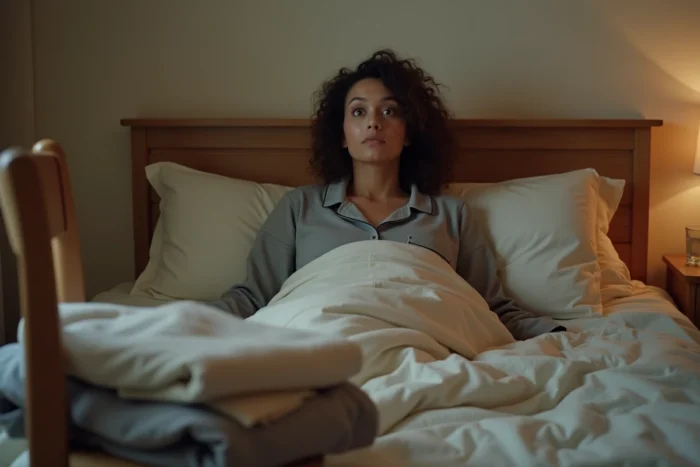
We’ve all noticed a detail in the arrangement of a bedroom that bothers us without being able to explain why. A desk chair placed directly in line with the bed, an empty armchair “facing” the sleeper, a work seat that comes into view when we open our eyes in the morning.
The question of sleeping facing a chair often comes up in discussions about feng shui and sleep, but it goes beyond mere belief. Recent studies in home ergonomics point to a concrete mechanism: the visual confusion between rest area and activity area disrupts falling asleep.
Chair facing the bed and cognitive alertness: what visible furniture changes
The problem is not the chair itself. It’s what it represents to the brain at the moment of falling asleep. When we see from our bed a seat associated with work, concentration, or effort, the brain maintains a state of alertness that delays what specialists call cognitive shutdown.
Research in occupational psychology and home ergonomics, particularly since the rise of remote work in 2020-2021, has documented this link. Seeing your desk or work chair from the bed increases professional rumination and extends the time it takes to fall asleep, especially among regular remote workers.
This phenomenon has a name in the literature: cognitive landmark confusion. One can also sleep in front of a chair according to CréAgencement to understand the feng shui reasons associated with this configuration, but the neurocognitive explanation stands independently of any tradition.
In summary, visually mixing work area and sleep area maintains a state incompatible with deep sleep. This applies to a desk chair, but also to a reading chair placed directly in front, or even an empty seat that captures the gaze.
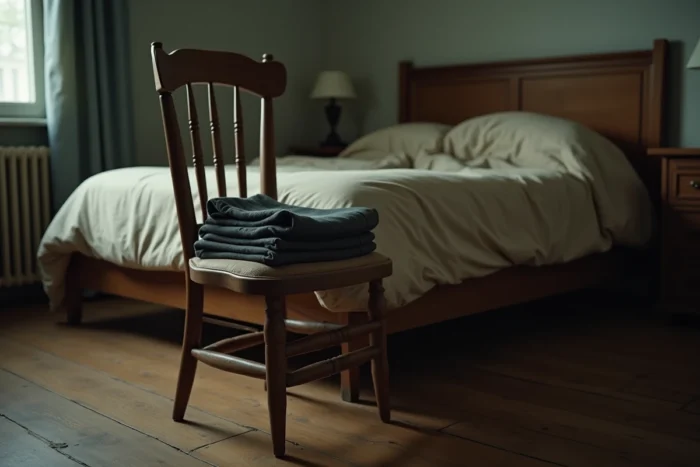
Superstition of the empty chair at the foot of the bed: origins and persistence
Feng shui classifies the bedroom in the yin category: calm, darkness, immobility. An empty seat turned towards the bed introduces a symbolic presence that contradicts this logic. According to the principles of chi circulation, any object that “faces” the sleeper sends active energy into a space that is supposed to remain passive.
In contemporary Chinese culture, this belief takes a very specific form. Media from Hong Kong and mainland China have been relaying a specific superstition since the 2010s: a bed whose foot faces an empty chair would invite spirits to sit and watch over the sleeper. This configuration is considered a “great taboo” in interior design.
A comparable pattern is found with mirrors facing the bed, another classic of feng shui. The mirror, yang by nature, reflects movement and light in a space that should remain still at night. The empty chair operates on a similar register: it embodies a place occupied by no one, creating a diffuse discomfort.
What these two superstitions share
- Both the mirror and the chair introduce a visual “presence” in the sleeper’s field of vision, disrupting the sense of intimacy necessary for rest.
- Both configurations are discouraged by feng shui for the same reason: they activate energy in a space that should remain yin.
- In both cases, rational explanations coexist with tradition: distracting reflections for the mirror, cognitive association with work for the chair.
Concrete bedroom arrangement: reduce visual stimuli facing the bed
We are not all going to reorganize our apartments based on feng shui. However, a few practical adjustments can help test the real impact of visible furniture on sleep quality.
Move or mask active furniture
The most direct solution is to remove the chair from the line of sight from the pillow. If the room does not allow it, a screen or curtain is enough to cut the line of sight between the bed and the seat. The idea is not to hide a piece of furniture, but to eliminate the visual stimulus that maintains alertness.
For those who work remotely in their bedroom, feedback varies on this point, but most ergonomists recommend at least turning the desk chair away from the bed or storing it under the desk at night.
Checklist for arranging a less disturbed sleep
- Check that the bed does not face a mirror, chair, or screen directly. These three objects share the same property: they capture the gaze at the moment of falling asleep.
- Prefer a headboard against a solid wall, without a window or door in the direct line. Feng shui sees this as an energy issue, while ergonomics sees it as a reduction of drafts and light variations.
- Limit furniture in the bedroom to its primary function: sleeping. Each object related to a daytime activity (desk, chair, exercise bike) sends a contradictory signal to the brain regarding rest.
- Turn off or mask any direct light source visible from a lying position, including standby lights from electronic devices.

Feng shui or neuroscience: should we choose a side?
The feng shui tradition and sleep ergonomics research often arrive at the same recommendations through different paths. Feng shui speaks of chi circulation, while neuroscience talks about contextual conditioning. The practical result is the same: a stripped-down sleep space without active furniture facing the bed promotes falling asleep.
The superstition of the empty chair that “invites spirits” has no measurable basis. However, the discomfort felt when sleeping facing an empty seat is documented. It falls under the same mechanism as the mirror facing the bed: a non-human visual presence that prevents the brain from considering the room as a safe and intimate space.
Whether one adheres to feng shui or sticks to sleep physiology, the recommendation remains the same. Removing the chair from the line of sight from the bed is a free test that takes only two minutes. The following nights usually provide the answer.