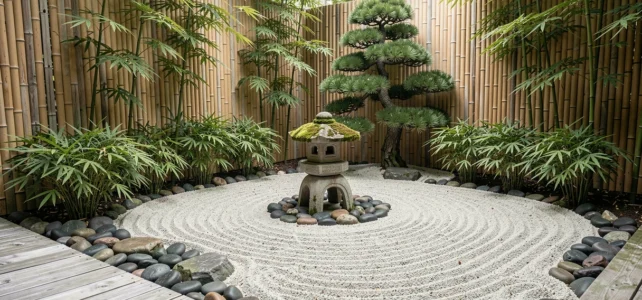
A plot of six meters by four, wedged between a terrace and a party wall: this is often the scale at which one embarks on a zen garden. The goal is not to replicate a temple in Kyoto, but to create a mineral and plant space that lasts over time, with realistic maintenance and materials suited to the local climate.
Maintenance of raked gravel: what the zen garden really requires
It is often said that the zen garden is “low maintenance.” Recent field reports say otherwise. According to Côté Maison, mineral surfaces and clean lines require regular interventions to maintain the desired effect. Raked gravel accumulates dead leaves, pollen, moss, and loses its patterns in just a few days of wind.
Specifically, this means raking once or twice a week to maintain the ripples. After rain, fine sand migrates to the edges and needs to be redistributed by hand. If you choose white gravel, expect a gradual graying that requires rinsing or partial replacement.
Before laying anything down, the soil must be prepared: excavate about ten centimeters, lay down a geotextile fabric with a sufficiently dense weight to block weeds, and then spread the gravel. Without this layer, weeds will break through in a few weeks. To find plants and materials compatible with this type of layout, you can access the Jardin Jade website which gathers useful references.
Water restrictions and dry gardens: why mineral landscapes are gaining ground

The connection between zen gardens and water-efficient dry gardens is not just aesthetic. With the increasing number of prefectural orders limiting garden watering during drought periods, a predominantly mineral space becomes a practical choice. Détente Jardin reminds us that watering can be restricted locally depending on drought episodes, complicating the lives of traditional flower beds.
La Passion du Paysage notes that by 2026, preferences are increasingly shifting towards dry gardens as a concrete alternative when seeking a more livable and less water-intensive space. The zen garden fits directly into this mineral logic.
This does not mean zero vegetation. We retain plants with low water needs: mosses in shaded areas, resilient grasses, or evergreen shrubs that withstand hot summers. The idea is to reduce the watered area without giving up on life.
Choosing stones and mineral composition of the zen garden
Stone is the skeleton of the zen garden. Unlike a decorative rock garden where stones are piled up, here each rock has a function in the composition. We work in odd groups (three, five, seven) to avoid symmetry, which disrupts the natural effect sought.
Some concrete guidelines for choosing your stones:
- Prefer local rocks: they integrate better with the soil and cost less to transport. Granite, schist, or sandstone work well depending on the region.
- Vary the shapes: a tall vertical stone, a low flat one, a rounded one. The contrast of silhouettes creates the visual tension characteristic of karesansui.
- Bury each stone about a third in the ground. A rock simply placed on the surface looks like it was just dropped yesterday, not naturally emerging from the ground.
- Test the composition before fixing anything: arrange the stones, step back several meters, and adjust. A block weighing several dozen kilos is not easily moved.
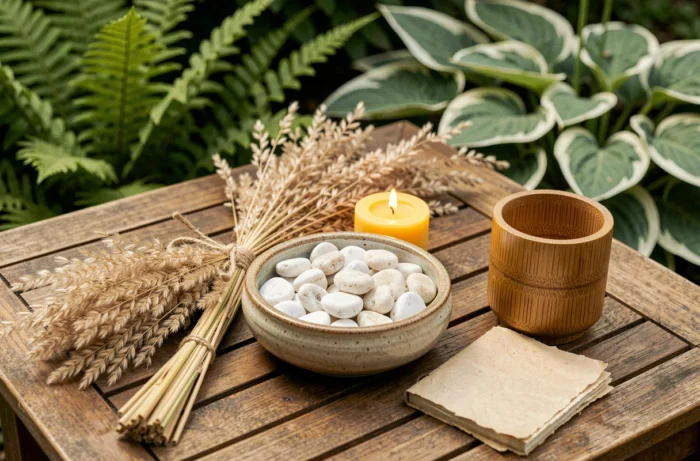
Fine sand or gravel complements the design. For a lasting ripple effect, a medium grain (neither too fine nor too coarse) withstands wind and rain better than very fine river sand.
Plants suitable for the zen garden: focus on structure rather than flowering
A common mistake is wanting too much color. A zen garden relies on textures, shapes, and greens. Flowering is a seasonal bonus, not the goal.
The plants that work best in this logic:
- Japanese maple (Acer palmatum): finely cut foliage, elegant form, autumn coloration. It tolerates partial shade and cool soils. Note that feedback varies on its resistance to high heat depending on the cultivars.
- Dwarf bamboo (Pleioblastus) or potted bamboo: adds verticality without invading the space, as long as its rhizomes are contained with a rhizome barrier.
- Mosses and helxines as ground cover: they replace grass in shaded areas and enhance the cozy atmosphere. They require moisture, so reserve them for areas protected from full sun.
- Persistent grasses like carex or ophiopogon: little watering, fine texture, green all year round.
Avoid neatly trimmed hedges and annual flower beds. Gentle pruning, in cloud form (niwaki), gives evergreen shrubs (boxwood, yew, variegated holly) rounded silhouettes that structure the space without rigidity.
Water in the zen garden: fountain or simple evocation
Water is not mandatory. In traditional karesansui, it is absent: the raked sand symbolizes it. If your space allows, a small closed-circuit fountain (tsukubai) provides a continuous sound of water that masks urban noises. The flow should remain low, more of a trickle than a jet.
For a discreet basin without a complex pump, a natural stone basin filled with rainwater is sufficient. It attracts birds, reflects the sky, and consumes nothing. Change the water regularly to avoid mosquitoes.
If you have neither the space nor the desire to manage a water feature, raked gravel in concentric circles around a central stone produces the same visual effect of rippling. This is indeed the most coherent solution in a small space where every square meter counts.
A successful zen garden relies less on accessories than on the rigor of the initial composition and the consistency of maintenance. It is better to have three well-placed stones and clean gravel than an overcrowded space filled with lanterns, bridges, and bamboo that ends up resembling a restaurant decor.