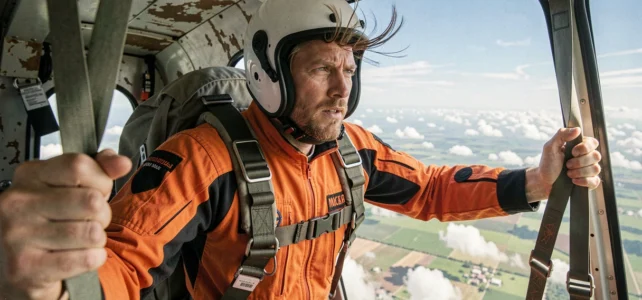
During a parachute jump, the body experiences pressure, speed, and temperature variations in just a few minutes that it does not encounter in any other common sports activity. This succession of physical stresses triggers a measurable hormonal cascade, well beyond the simple thrill felt on roller coasters. Understanding what actually happens in the body allows for a more lucid approach to jumping, often with less apprehension.
Physiological response of the body during free fall
Have you ever noticed your heart racing just by looking into the void from a balcony? During a parachute jump, this reaction is amplified by a factor that everyday life does not replicate: the total disappearance of the ground beneath your feet.
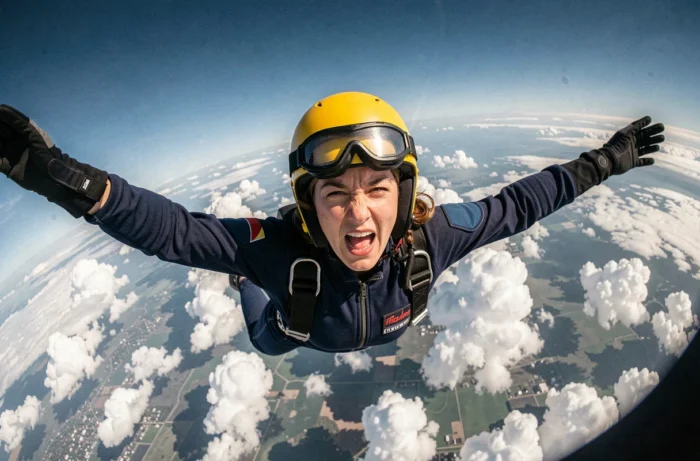
At the moment of leaving the plane, the sympathetic nervous system takes over. The adrenal glands release adrenaline and cortisol in large quantities. The heart rate rises significantly above resting frequency. The pupils dilate, breathing accelerates, and the muscles tense.
This mechanism, known as the “fight or flight” response, is completely normal. It is a programmed survival reaction. The body prepares for maximum effort in just a few seconds. The difference with a sprint or a weightlifting session is that this discharge occurs without voluntary muscle movement. You are stationary in the airflow, but your body functions as if you were running.
To better grasp the intensity of a parachute jump, it is important to consider that this hormonal surge lasts well after landing. The post-jump euphoria, often described by jumpers, corresponds to the release of endorphins that follows the stress peak.
Atmospheric pressure and effects on the inner ear
One aspect rarely discussed in jump accounts concerns pressure variation. Upon leaving the drop altitude to reach the ground, the body passes through a column of air whose density increases rapidly.
The inner ear undergoes a pressure change comparable to a rapid descent in a commercial airplane, but concentrated over a much shorter duration. This phenomenon can cause temporary discomfort or even a feeling of clogged ears. Swallowing or yawning during the descent under the canopy helps to equalize the pressure on either side of the eardrum.
This pressure issue explains why a cold or sinusitis on the day of the jump can turn the experience into an unpleasant moment. The Eustachian tubes, congested, can no longer compensate properly. Jumping with clear airways is a practical guideline not to overlook.
Effect of relative wind on the skin and breathing
During free fall, the airflow strikes the face at considerable speed. The skin slightly deforms under aerodynamic pressure. Breathing requires a small conscious effort, not because air is lacking, but because the natural reflex pushes one to hold their breath against the wind.
The temperature also drops. At the drop altitude, the air is noticeably colder than at ground level. In just a few tens of seconds of free fall, the body transitions from a cool environment to more temperate air. This rapid thermal contrast contributes to the sensory awakening sensation described by many jumpers.
Medical certificate and parachuting: what has changed in France
Until recently, parachuting was listed among the sports with specific constraints requiring a specific medical certificate to obtain a license. A decree dated August 31, 2023, removed parachuting from this list in the Sports Code.
The legal obligation for a specific medical certificate has been relaxed since 2023. In practice, the administrative process for regular practitioners has been simplified. Federations retain the option to require an annual certificate through their own medical regulations, but this is no longer an automatic legal requirement.
For a tandem jump, the situation remains distinct. The jumper does not need a federal license. The parachuting center generally requires filling out a health questionnaire and may require a medical opinion in case of doubt. This framework aims to verify that the body can withstand the stresses described above, particularly pressure variation and cardiovascular strain.
Here are the situations that justify a prior medical opinion:
- Cardiac history or treatment for hypertension, as the adrenaline spike places significant stress on the cardiovascular system
- Recurring ENT problems (ear infections, chronic sinusitis), due to rapid pressure variations on the inner ear
- Back or joint pathologies, as the parachute opening generates a sharp deceleration transmitted to the harness
- Epilepsy or neurological disorders that may be triggered by intense stress
Deceleration at parachute opening: what the harness transmits to the body
The least described phase in testimonials remains the opening of the canopy. During free fall, the body reaches a stabilized speed. When the instructor deploys the parachute, the deceleration is sharp.
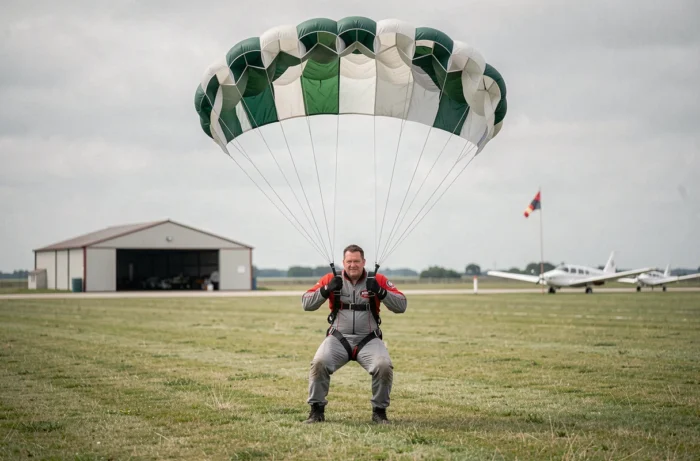
The transition from free fall speed to descent under the canopy takes a few seconds. The harness distributes the force across the shoulders, thighs, and pelvis. A poorly adjusted harness can create uncomfortable pressure points, which is why the instructor pays close attention during ground equipment.
This deceleration often causes a sensation of “rising,” as if the body is being pulled upward. In reality, it is the speed that drops suddenly. The brain, accustomed to the velocity of free fall, interprets the slowdown as an upward movement. This perceptual shift is one of the most surprising moments of the jump.
Under canopy: the sensory contrast
After the opening, silence replaces the sound of the wind. The heart rate begins to decrease. The landscapes become clearer, and the ground slowly approaches. This is the phase where the body shifts from alert mode to active recovery.
Hands may tremble, legs may feel weak. These reactions reflect the decrease in cortisol. They are normal and disappear within minutes after landing.
The parachute jump condenses in just a few minutes the demands that the body usually takes hours to process during prolonged physical effort. Pressure variation, hormonal discharge, deceleration, thermal contrast: each phase imposes a rapid adaptation of the organism. It is this accumulation, more than speed alone, that makes the experience physically unique.