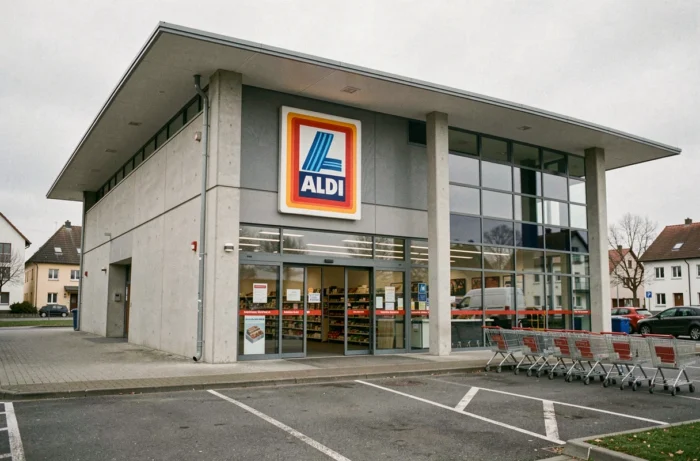
When you push open the door of an Aldi store, the decor is stripped down, products are displayed on pallets, and the selection remains deliberately limited. This discount model, born in Germany over a century ago, is based on precise mechanisms that explain such low prices. Aldi is not a traditional supermarket that has reduced its margins; it is a business logic designed from the outset to eliminate every unnecessary cost.
Non-food arrivals at Aldi: discount as a driver of visits
We associate Aldi with food, but the brand is increasingly using non-food items as a traffic lever. Since 2026, Aldi France has been structuring short-term operations in textiles, home goods, DIY, and seasonal products. The idea is not to become a general hypermarket.
The principle is based on short, limited edition arrivals: a batch arrives in the store, it sells out in a few days, and it is not restocked. This mechanism creates a habit of regular visits among customers who do not want to miss a good deal.
Summer 2026 marked a turning point with the launch of Aldi Studio, presented as the first textile capsule collection of the brand in France, linked to the in-house brand UP 2 FASHION. This type of operation shows that discount is no longer limited to the grocery basket. Textiles and seasonal items serve as a means of image support and differentiation against Lidl or Action, which occupy the same space. To better understand the prices at Aldi and its stores, one must integrate this non-food dimension into the equation.

Aldi Nord and Aldi Süd: two distinct companies behind the same name
Confusion is common. Aldi is not a single company, but two legally and operationally separate entities since the 1960s. Aldi Nord and Aldi Süd share the world without competing directly: each branch operates in defined territories.
In France, it is Aldi Nord (renamed ALDI at the group level) that operates the store network. Aldi Süd, on the other hand, is present in the UK, Australia, and the United States. The separation dates back to a disagreement between the two Albrecht brothers, founders of the brand, over the sale of cigarettes in stores.
Concrete consequences of this split
The two branches do not share their purchasing policies, private labels, or development strategies. A product sold at Aldi in France has no reason to be found at Aldi in the United States. Returns vary on the comparative quality of the two networks, but the cost structure remains similar: limited assortment, majority private label brands, reduced sales area.
- Aldi Nord covers northern Germany, France, Belgium, the Netherlands, Poland, and several other European markets.
- Aldi Süd operates in southern Germany, the UK, Australia, Italy, and the United States.
- The two entities do not merge their purchases, meaning supplier negotiations are independent from one network to another.
The Aldi hard discount model: what lowers prices in-store
The term “hard discount” has been overused, but at Aldi it refers to a coherent system. Every operational decision aims to eliminate a cost item, and the difference is reflected on the price tag.
Limited assortment and private labels
An Aldi store offers on average far fewer references than a traditional supermarket. This restriction is intentional. Fewer references mean concentrated purchase volumes for each product, thus a stronger negotiating power with suppliers. The vast majority of the assortment consists of private label brands (PL), which eliminates marketing costs associated with national brands.
Reduced space and simplified logistics
Aldi stores are smaller than traditional supermarkets. Products often arrive on pallets that serve directly as displays. No complex shelving, no elaborate decoration, and little staff relative to the sales area. This operation reduces fixed costs per store.
Low prices are not a marketing argument at Aldi; they are the mechanical result of logistical choices. The reduction in the number of references, the predominance of PL, and the simplicity of the stores create a system where each element reinforces the others.

Aldi in the French discount market: positioning and competitors
In France, Aldi faces a dense competitive landscape. Lidl, stemming from the same German model, has gained an advantage by moving upmarket earlier. Non-food brands like Action capture part of the discount traffic in the home and leisure segment.
Aldi has long maintained a “hard” positioning in France, with stores that are more austere than those of Lidl. The brand has gradually renovated its store network and expanded its offerings, particularly in fresh produce (fruits, vegetables, bakery). The shift towards structured non-food items, with operations like Aldi Studio, is part of this desire to no longer be perceived solely as a basic food discounter.
In terms of market share, Aldi is seeking to catch up with Lidl in the French territory. The opening of new points of sale continues, such as in Champagnole at the end of September 2026. The strategy combines network densification and modernization of the in-store experience.
The Aldi model remains a case study in discount retail. More than a century after the opening of the first Albrecht grocery store in Germany, the founding logic has not changed: to offer less choice, but at the fairest price, by eliminating every extra cost between the supplier and the customer’s cart.